Usage
Simulation
You can simulate the enrgy flow of a photovoltaic system with energy storage using an OutputCalculator object. You can recieve financial data and stats on a system after the simulation using a FinancialCalcualtor object.
Energy flow simulation
To simulate a photovoltaic system with energy storage you need to create 2 objects: Producer and PowerStorage
You can create a producer using 3 options:
using a file with hourly energy output of a year (see :code:’test.csv’ file for an example)
using pvgis api to recieve hourly data of a year
using pvlib to calculate the hourly energy output of a year
Create a producer using file with:
from optibess_algorithm.producers import PvProducer

prod = PvProducer(pv_output_file="test.csv", pv_peak_power=13000)
pv_output_fileis the name of the filepv_peak_poweris the rated power of the producer.
you can also specify the timezone of the system with parameter timezone (defualt is Jerusalem timezone).
Create a producer using pvgis with:
from optibess_algorithm.producers import PvProducer, Tech

prod = PvProducer(latitude=30.02, longitude=34.84, tilt=16, azimuth=0, tech=Tech.TRACKER, pv_peak_power=10000, losses=9)
latitudeandlongitudespecify the location of the systemtiltis the angle of the modules from the groundazimuthis the direction the module are facing (0 is south)techis the type of modules used in the system (FIXED,TRACKER, orEAST_WEST)pv_peak_poweris the rated power of the producer.lossesis the overall PV system losses
Create a producer using pvlib with:
from optibess_algorithm.pv_output_calculator import MODULE_DEFAULT, INVERTER_DEFAULT
from optibess_algorithm.producers import PvProducer, Tech

prod = PvProducer(latitude=30.02, longitude=34.84, tilt=16, azimuth=0, tech=Tech.EAST_WEST, modules_per_string=10,
                  strings_per_inverter=2, number_of_inverters=1000, module=MODULE_DEFAULT, inverter=INVERTER_DEFAULT,
                  use_bifacial=True, albedo=0.2)
latitudeandlongitudespecify the location of the systemtiltis the angle of the modules from the groundazimuthis the direction the module are facing (0 is south)techis the type of modules used in the system (FIXED,TRACKER, orEAST_WEST)modules_per_stringis the number of module in each electronic stringstrings_per_inverteris the number of string connected to each inverternumber_of_invertersis the number of inverters in the PV systemmoduleis a pandas series with parameters for the moduleinverteris a pandas series with parameters for the inverteruse_bifacialis a boolean idicating if the system uses bifacial calculationalbedois the fraction of sunlight diffusely reflected by the ground
Create a power storage with:
from optibess_algorithm.power_storage import LithiumPowerStorage

power_storage = LithiumPowerStorage(num_of_years=25, connection_size=5000, block_size=500, battery_hours=2,
                                    use_default_aug=True)
num_of_yearis the number of years the storage system will be usedgrid_sizeis the size of the connection to the grid (in kW)block_sizeis the size of each block in the storage systembattery_hoursis the number of hours the storage system should supply each day (used to determine the size of the system)use_default_augis a boolean idicating using a default augmentation configuration
The size of the system is determined by an augmentation table with the month each augmentation is installed and the number of blocks in each augmentation. When battery_hours is specified and use_default_aug is true we use 3 augmentations. The first augmentation is in the 0 month (system initial construction) with size that suffice for supplying battery_hours times grid_size (with extra for losses), and adding about 20% after 8 and 16 years. If use_default_aug is false only uses te first augmentation.
Additional parameters:
deg_table,dod_tableandrte_tableare 3 listed of values between 0 and 1, specifying the degradation, depth of discharge and round trip efficiency for each yearpcs_loss,mvbat_lossandtrans_lossare different losses in the systemidle_self_consumptionandactive_self_consumptionare the percentage of the nominal storage system (nameplate) the battery consumes in each hour for its operation (active for hours wher charging/discharge and idle for the rest of the hours)aug_tableis an option to specify the augmentation table directly
Using these objects, create and run an OutputCalculator with:
from optibess_algorithm.output_calculator import OutputCalculator
from optibess_algorithm.producers import PvProducer
from optibess_algorithm.power_storage import LithiumPowerStorage

import numpy as np

power_storage = LithiumPowerStorage(num_of_years=25, connection_size=5000, block_size=500, battery_hours=2,
                                    use_default_aug=True)
prod = PvProducer("test.csv", pv_peak_power=13000)
output = OutputCalculator(num_of_years=25, grid_size=5000, producer=prod, power_storage=power_storage,
                          producer_factor=1, save_all_results=True)
# run simulation
output.run()

# change print options to show full rows of the matrix
np.set_printoptions(linewidth=1000)
print(output.monthly_averages())
monthly_averages return a matrix with the average of the given stat (default total energy output) in each hour
of the day for each month, in the given year range (default first year only). You can also use plot_stat
function with similar parameters to plot a stat.
Parameters:
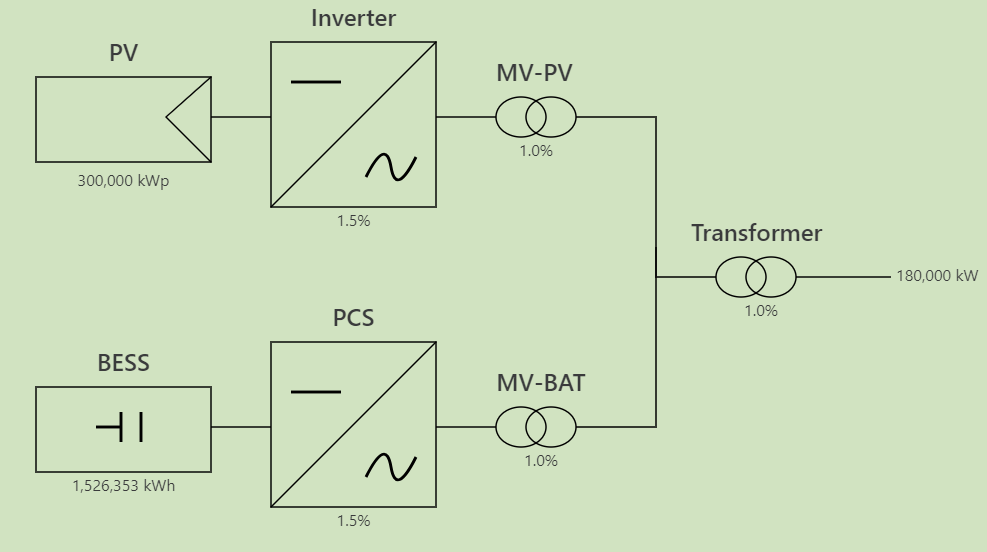
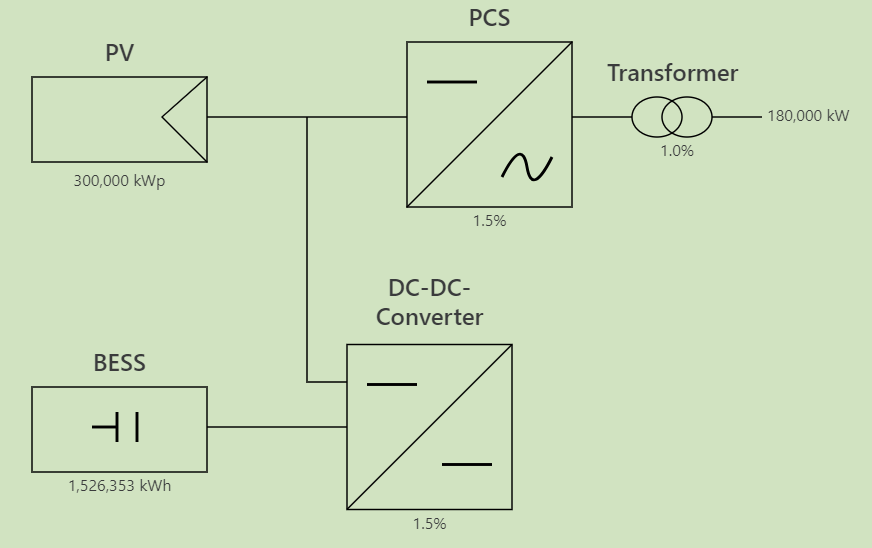
num_of_yearis the number of years the system will be usedgrid_sizeis the size of the connection to the grid (in kW)produceris a producer objectpower_storageis a power_storage objectcouplingis the type of coupling (AC/DC) used in the system (below are diagram of the 2 options)mvpv_loss,trans_loss,mvbat_loss,pcs_lossanddc_dc_lossare the different system lossesbess_discharge_houris the hour the system start to discharge the storagefill_battery_from_gridis a boolean idicating if the battery is filled from the grid when the producer power is not sufficient to fill the batterysave_all_resultsis a boolean idicating saving all the data for all the simulation years (and also save additional stats needed for some of the financial calculations)producer_factoris a number between 0 and 1 which the producer output is multiplied by
Financial calculations
After creating an output calculator you can pass it to a financial calculator that has methods for calculating several financial stats and financial data:
from optibess_algorithm.output_calculator import OutputCalculator
from optibess_algorithm.constants import *
from optibess_algorithm.producers import PvProducer
from optibess_algorithm.power_storage import LithiumPowerStorage
from optibess_algorithm.financial_calculator import FinancialCalculator

import time

storage = LithiumPowerStorage(25, 5000, aug_table=((0, 83), (96, 16), (192, 16)))
producer = PvProducer("test.csv", pv_peak_power=15000)

output = OutputCalculator(25, 5000, producer, storage, save_all_results=True, fill_battery_from_grid=False,
                          bess_discharge_start_hour=17, producer_factor=1)
fc = FinancialCalculator(output_calculator=output, land_size=100, capex_per_land_unit=215000, capex_per_kwp=370,
                         opex_per_kwp=5, battery_capex_per_kwh=170, battery_opex_per_kwh=5,
                         battery_connection_capex_per_kw=50, battery_connection_opex_per_kw=0.5, fixed_capex=150000,
                         fixed_opex=10000, interest_rate=0.04, cpi=0.02, battery_cost_deg=0.07, base_tariff=0.14,
                         winter_low_factor=1.1, winter_high_factor=4, transition_low_factor=1,
                         transition_high_factor=1.2, summer_low_factor=1.2, summer_high_factor=6,
                         buy_from_grid_factor=1)
start_time = time.time()
output.run()
print("irr: ", fc.get_irr())
print("npv: ", fc.get_npv(5))
print("lcoe: ", fc.get_lcoe())
print("lcos: ", fc.get_lcos())
print("lcoe no grid power:", fc.get_lcoe_no_power_costs())
print(f"calculation took: {(time.time() - start_time)} seconds")
The financial stats caluclated:
irris the internal rate of return of the systemnpvis the net present value of the systemlcoeis the levelized cost of energy of the system (energy produced and purchased)lcosis the levelized cost of storage of the systemlcoe no grid poweris lcoe of the power from PV only
parameters:
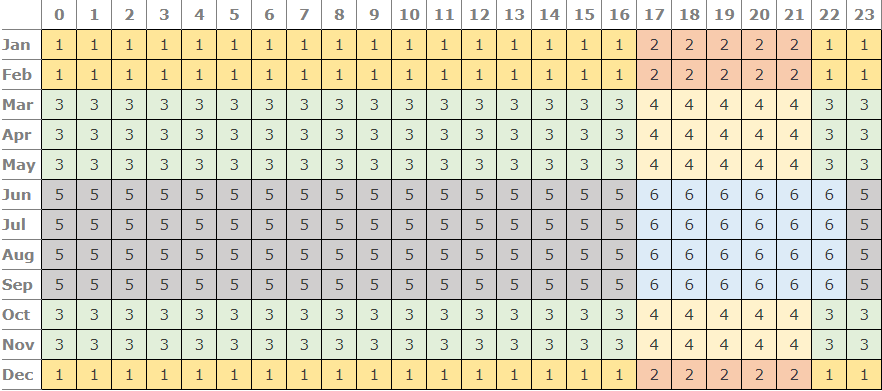
output_calcualtoris an OutputCalculator objectland_sizeis the size of land used for the systemcapex/opexare the cost of the system separated into 5 categories: by land size, by PV size, by battery size, by the size of the connection to the battery and misc.usd_to_ilsis a convertion rate from us dollars to israeli new shekelinterest_rateis the market interest ratecpiis the consumer price indexbattery_deg_costis the annual reduction of battery cost (in percentage)base_tariffis the base tariff used to construct the tariff tablelow/high_winter/transition/summer_factorare factors by which the the base tariff is multiplied to create the tariff tablebuy_from_grid_factoris a factor by which to multiply a tariff to get the prices of buy powertariff_tableis an option to specify the tariff table directly
The tariff table is constructed according to the following table:
Note
The current version is only suited for working with tariffs with similar structure to the table above
Diagrams of the system
AC coupling:
DC coupling:
Optimization
You can run an optimization on an example system with:
import logging
import time
from optibess_algorithm.power_system_optimizer import NevergradOptimizer

# make info logging show
logging.getLogger().setLevel(logging.INFO)
# start optimization
start_time = time.time()
optimizer = NevergradOptimizer(budget=100)
opt_output, res = optimizer.run()
# print results
print(optimizer.get_candid(opt_output), res)
print(f"Optimization took {time.time() - start_time} seconds")
The outputs of the optimizer run method are the parameters of the optimal result (augmentation table and PV size factor) and the optimal result (the irr of the system with these parameters).
Run an optimization on a custom system with:
from optibess_algorithm.constants import MAX_BATTERY_HOURS
from optibess_algorithm.financial_calculator import FinancialCalculator
from optibess_algorithm.output_calculator import OutputCalculator
from optibess_algorithm.power_storage import LithiumPowerStorage
from optibess_algorithm.producers import PvProducer
from optibess_algorithm.power_system_optimizer import NevergradOptimizer

import logging
import time
# make info logging show
logging.getLogger().setLevel(logging.INFO)
# setup power system
storage = LithiumPowerStorage(25, 5000, use_default_aug=True)
producer = PvProducer("test.csv", pv_peak_power=15000)
output = OutputCalculator(25, 5000, producer, storage, save_all_results=False)
finance = FinancialCalculator(output, 100)

# start optimization
start_time = time.time()
optimizer = NevergradOptimizer(financial_calculator=finance, use_memory=True, max_aug_num=6, initial_aug_num=3,
                               budget=2000)
opt_output, res = optimizer.run()
# print results
print(optimizer.get_candid(opt_output), res)
print(f"Optimization took {time.time() - start_time} seconds")
financial_calculatoris a FinancialCalcualtor objectuse_memoryis a boolean idicating if the optimizer will use a memory dict to get result of repeating queries quicklymax_aug_numis the maximum number of augmentations the optimizer will try in a solutioninitial_aug_numis the number of augmentation in the initial guessbudgetis the number of simulation to use for optimization
Additional parameters for Nevergrad optimizer:
max_no_change_stepsis the maximum number of optimization step with no change before stopping (if none, does not use early stopping)min_change_sizeis the minimum change between steps to consider as a change for early stoppingverbosityis print information from the optimization algorithm (0: None, 1: fitness values, 2: fitness values and recommendation)